
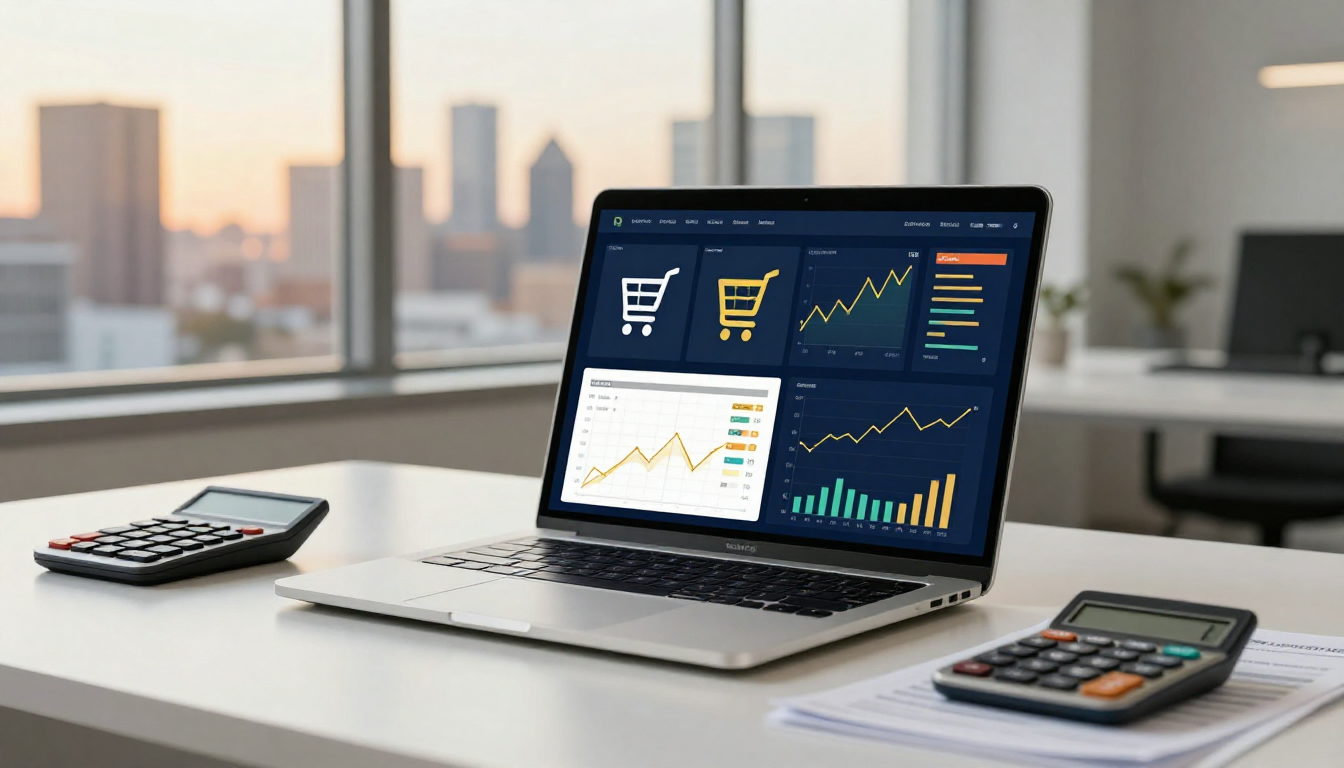
Optimizing Cost with Advanced Accounting Analytics in E-commerce
Optimizing cost with advanced accounting analytics in e-commerce
Introduction
In today’s competitive e-commerce landscape, managing costs effectively has become a critical differentiator between thriving businesses and those struggling to maintain profitability. Advanced accounting analytics offer a powerful solution for e-commerce companies seeking to understand, monitor, and optimize their expenses across every operational dimension. Rather than relying on traditional accounting methods that provide only a retrospective view of finances, modern analytics tools enable real-time visibility into cost drivers, spending patterns, and operational inefficiencies. This article explores how e-commerce businesses can leverage sophisticated accounting analytics to identify cost reduction opportunities, improve financial decision-making, and ultimately enhance their bottom line. By implementing these advanced techniques, companies can transform raw financial data into actionable insights that drive sustainable growth and competitive advantage.
Understanding cost structure in e-commerce operations
E-commerce businesses operate in a fundamentally different cost environment than traditional retail, with expenses distributed across multiple interconnected channels and operational areas. To effectively optimize costs, companies must first develop a comprehensive understanding of their unique cost structure and how various expenses interact with business performance metrics.
The primary cost categories in e-commerce typically include product costs, fulfillment expenses, platform and technology fees, marketing and customer acquisition expenses, payment processing costs, and overhead. Each of these categories contains numerous subcategories and hidden costs that may not be immediately apparent without detailed analysis. For instance, fulfillment expenses extend far beyond shipping costs to encompass warehouse labor, equipment depreciation, inventory shrinkage, returns processing, and last-mile delivery challenges.
Understanding cost structure becomes increasingly complex when considering how different product types, customer segments, and sales channels generate vastly different expense profiles. A high-value, low-volume product sold through a direct channel creates entirely different cost dynamics compared to a low-value, high-volume item distributed through marketplace channels. Without granular visibility into these distinctions, management teams operate with incomplete information when making strategic decisions.
Advanced accounting analytics enable businesses to segment their cost structure according to multiple dimensions simultaneously. Rather than viewing costs as monolithic line items, analytics platforms can break down expenses by product category, customer segment, sales channel, geographic region, time period, and supplier. This multidimensional approach reveals patterns and relationships that traditional accounting frameworks obscure, allowing decision-makers to identify which business segments are truly profitable and which may be operating at a loss when all costs are properly allocated.
Implementing predictive modeling for expense forecasting
One of the most transformative applications of advanced accounting analytics in e-commerce is the ability to move beyond historical reporting toward predictive modeling and expense forecasting. While backward-looking financial statements provide valuable context, forward-looking analytics empower businesses to anticipate costs before they occur and adjust operations proactively.
Predictive modeling leverages historical data combined with external variables to forecast future expenses with increasing accuracy. Machine learning algorithms can identify patterns in seasonal fluctuations, identify how changes in sales volume impact various cost categories, and even predict the likelihood of supplier price increases based on market conditions. This capability proves invaluable for e-commerce businesses that experience significant seasonality, as managers can adjust inventory levels, staffing, and fulfillment capacity in advance of peak periods rather than reacting to cost overruns after the fact.
Consider the following typical expense forecasting applications:
- Shipping cost prediction: By analyzing historical shipping data, package weights, destination zones, and carrier rate changes, analytics systems can forecast shipping expenses for various sales scenarios, enabling better pricing decisions
- Inventory carrying cost projection: Predictive models can estimate the total cost of holding inventory based on purchase patterns, storage costs, and expected inventory turnover rates
- Labor demand forecasting: By correlating sales volume with historical labor hours and productivity metrics, companies can anticipate staffing needs and associated payroll costs
- Returns and refund estimation: Analytics can predict the financial impact of returns based on product category, customer segment, and seasonal factors
- Payment processing fee projection: Advanced systems can forecast processing costs by modeling expected transaction volumes and payment method distribution
The practical benefit of these forecasting capabilities extends to budgeting and financial planning processes. Rather than constructing budgets based on historical averages or management assumptions, finance teams can ground their projections in data-driven models that account for business growth, market conditions, and operational changes. This results in more accurate budgets that serve as meaningful planning tools rather than arbitrary financial constraints.
Identifying and eliminating cost leakage across channels
Cost leakage represents one of the most insidious challenges in e-commerce accounting, as inefficiencies and hidden expenses often hide within the complexity of multi-channel operations. Advanced analytics excel at detecting these leaks by comparing expected costs against actual performance and identifying anomalies that warrant investigation.
In a typical e-commerce organization, cost leakage manifests in numerous ways. Payment processing fees might vary significantly across different payment methods or geographic regions due to hidden markups and currency conversion charges. Shipping costs might bloat due to inefficient box sizes that result from poor packaging optimization. Marketplace fees and commissions might accumulate unnoticed as different products sell through multiple channels at varying rate structures. Customer acquisition costs might diverge dramatically between marketing channels, with underperforming channels continuing to receive budget allocation based on outdated assumptions.
Consider the following real-world example of cost leakage in e-commerce: A company selling across their owned website, Amazon, eBay, and social commerce platforms might fail to notice that fulfillment costs for Amazon orders consistently exceed those for direct website orders by 40 percent. This discrepancy might stem from Amazon’s warehouse location requirements, the customer demographic served through each channel, or different return rates. Without detailed analytics that isolate costs by channel and product, this inefficiency could persist indefinitely, gradually eroding profitability.
Advanced accounting analytics address cost leakage through several mechanisms. Automated exception reporting flags expenses that deviate from expected ranges, alerting managers to investigate anomalies. Comparative cost analysis enables side-by-side evaluation of how similar transactions are processed through different systems or channels, revealing discrepancies. Drill-down capability allows analysts to navigate from summary-level reporting into granular transaction details, tracing specific costs back to their origin points.
The following table illustrates how cost per order varies significantly across different sales channels even for identical products:
| Sales channel | Average order value | Product cost | Fulfillment cost | Payment processing | Platform fees | Marketing allocation | Total cost per order | Gross margin |
|---|---|---|---|---|---|---|---|---|
| Direct website | $75.00 | $20.00 | $4.50 | $2.10 | $0.00 | $8.00 | $34.60 | 53.9% |
| Amazon FBA | $72.00 | $20.00 | $9.80 | $2.00 | $8.64 | $0.00 | $40.44 | 43.8% |
| eBay | $68.00 | $20.00 | $5.20 | $2.05 | $4.76 | $5.00 | $37.01 | 45.6% |
| Instagram shop | $85.00 | $20.00 | $6.00 | $2.55 | $2.55 | $12.00 | $43.10 | 49.3% |
This data reveals that Amazon FBA, despite being a major sales channel, delivers significantly lower gross margins due to high fulfillment and platform fees. Without this level of analytical visibility, management might incorrectly assume that growing Amazon sales volume is beneficial to the business, when in fact prioritizing direct website sales would be more profitable.
Optimizing supplier relationships and procurement costs
Supplier management represents another critical area where advanced accounting analytics generate substantial cost optimization opportunities. Most e-commerce companies work with multiple suppliers for various product categories, and the relationship between purchasing decisions, pricing structures, and total cost of ownership is rarely straightforward.
Traditional procurement approaches often focus narrowly on unit cost, selecting the supplier offering the lowest per-unit price without considering other cost factors. Advanced analytics reveal that this approach frequently results in suboptimal total cost outcomes. A supplier with a slightly higher unit price might offer more favorable payment terms, lower defect rates, faster delivery times, or smaller minimum order quantities. Each of these factors carries financial implications that ripple through the entire business.
Analytics-driven supplier optimization begins with calculating total cost of ownership for each supplier relationship, moving beyond unit pricing to incorporate factors such as:
- Quality metrics and defect rates that translate to returns and customer dissatisfaction
- Lead times and their impact on inventory carrying costs and stockout risks
- Minimum order quantities and their effect on inventory levels and cash flow
- Payment terms and their influence on working capital requirements
- Logistics and freight costs varying by supplier location and order size
- Compliance and certification costs associated with supplier requirements
By quantifying these elements, finance and procurement teams can make supplier selection decisions based on comprehensive cost analysis rather than incomplete information. A supplier with a 15 percent higher unit cost but superior quality, shorter lead times, and more favorable payment terms might deliver 20 percent lower total cost of ownership.
Advanced analytics also enable dynamic pricing optimization within supplier relationships. Rather than negotiating fixed pricing at the beginning of annual contracts, analytics-driven approaches monitor market conditions, competitor pricing, and purchase volumes continuously. This enables procurement teams to identify windows of opportunity to renegotiate terms, consolidate purchases for volume discounts, or adjust product sourcing to capitalize on favorable market conditions.
Furthermore, analytics can identify product-level supplier performance variations that might otherwise remain hidden. A supplier might deliver excellent results for one product category while performing poorly in another. Analytics systems can flag these variations and recommend supplier switches at the product level rather than maintaining single suppliers across all offerings.
Conclusion
Advanced accounting analytics have fundamentally transformed how e-commerce businesses approach cost optimization. By providing real-time visibility into cost structures, enabling predictive modeling and expense forecasting, identifying hidden cost leakage, and informing supplier relationship decisions, modern analytics platforms empower organizations to achieve sustainable improvements in profitability and operational efficiency. The transition from traditional retrospective accounting to data-driven financial analysis requires investment in technology infrastructure, analytical talent, and organizational processes, but the return on that investment becomes apparent quickly as cost optimization opportunities are identified and eliminated. Moving forward, e-commerce companies that fail to embrace advanced accounting analytics risk gradually losing competitive advantage as their more analytically sophisticated competitors optimize their cost bases with increasing precision. The future belongs to organizations that treat financial data as a strategic asset rather than a compliance requirement, leveraging analytics not merely to understand past performance but to actively shape and improve future results through informed decision-making grounded in comprehensive, accurate, and timely financial intelligence.

news via inbox
Nulla turp dis cursus. Integer liberos euismod pretium faucibua



