Optimizing Business Intelligence with Data Analytics and Cloud Accounting for SMBs
Optimizing Business Intelligence with Data Analytics and Cloud Accounting for SMBs
Introduction
In today’s competitive marketplace, small and medium-sized businesses (SMBs) face unprecedented pressure to make data-driven decisions without the resources of larger enterprises. The convergence of data analytics and cloud accounting has fundamentally transformed how SMBs can harness business intelligence to drive growth and profitability. Rather than relying on intuition or outdated spreadsheets, modern SMBs now have access to affordable, scalable solutions that enable real-time financial insights and predictive analytics. This article explores how integrating these technologies creates a powerful framework for SMB success. We’ll examine the core benefits of cloud accounting platforms, the role of data analytics in decision-making, and practical strategies for implementation that maximize return on investment while minimizing complexity and cost.
Understanding the cloud accounting revolution for SMBs
Cloud accounting has revolutionized financial management for small and medium-sized businesses by eliminating the need for expensive on-premise infrastructure and IT support. Unlike traditional accounting software installed on individual computers, cloud-based solutions provide accessibility from anywhere, automatic updates, and built-in security protocols that would cost thousands to implement independently.
The shift to cloud accounting represents more than just convenience. For SMBs, it means leveling the playing field with larger competitors. A company with five employees can now access the same financial tools and capabilities that a company with fifty employees uses. This democratization of technology has profound implications for how businesses manage cash flow, process invoices, and prepare financial statements.
Key advantages of cloud accounting platforms include:
- Real-time financial visibility: Business owners can access balance sheets, profit and loss statements, and cash flow reports instantly rather than waiting for monthly or quarterly closures
- Collaboration capabilities: Accountants, bookkeepers, and business owners can work simultaneously on the same financial records without version control issues
- Integration with banking systems: Automatic bank feeds reduce manual data entry and improve accuracy
- Mobile accessibility: Process transactions, approve expenses, and monitor finances from smartphones or tablets
- Scalability: As your business grows, the system grows with you without expensive upgrades
- Automatic compliance: Tax calculations and regulatory updates happen automatically
The financial impact is substantial. Research shows that SMBs using cloud accounting reduce accounting time by 40 percent on average, freeing resources for strategic activities. Additionally, the cloud model eliminates capital expenditures for servers and reduces ongoing IT maintenance costs.
| Feature | Traditional accounting software | Cloud accounting |
|---|---|---|
| Initial cost | $500-$2,000 per license | $20-$100 monthly subscription |
| Data access | Single workstation or limited network | Anywhere with internet connection |
| Updates | Manual, often costly | Automatic and included |
| Security responsibility | Business owner | Vendor manages |
| Collaboration | Limited and cumbersome | Built-in and seamless |
| Scalability | Requires new purchases | Automatic with subscription tier |
Data analytics as the strategic advantage
While cloud accounting provides the foundation for financial management, data analytics transforms that information into actionable intelligence. The difference is crucial: accounting tells you what happened, while analytics helps you understand why it happened and what might happen next.
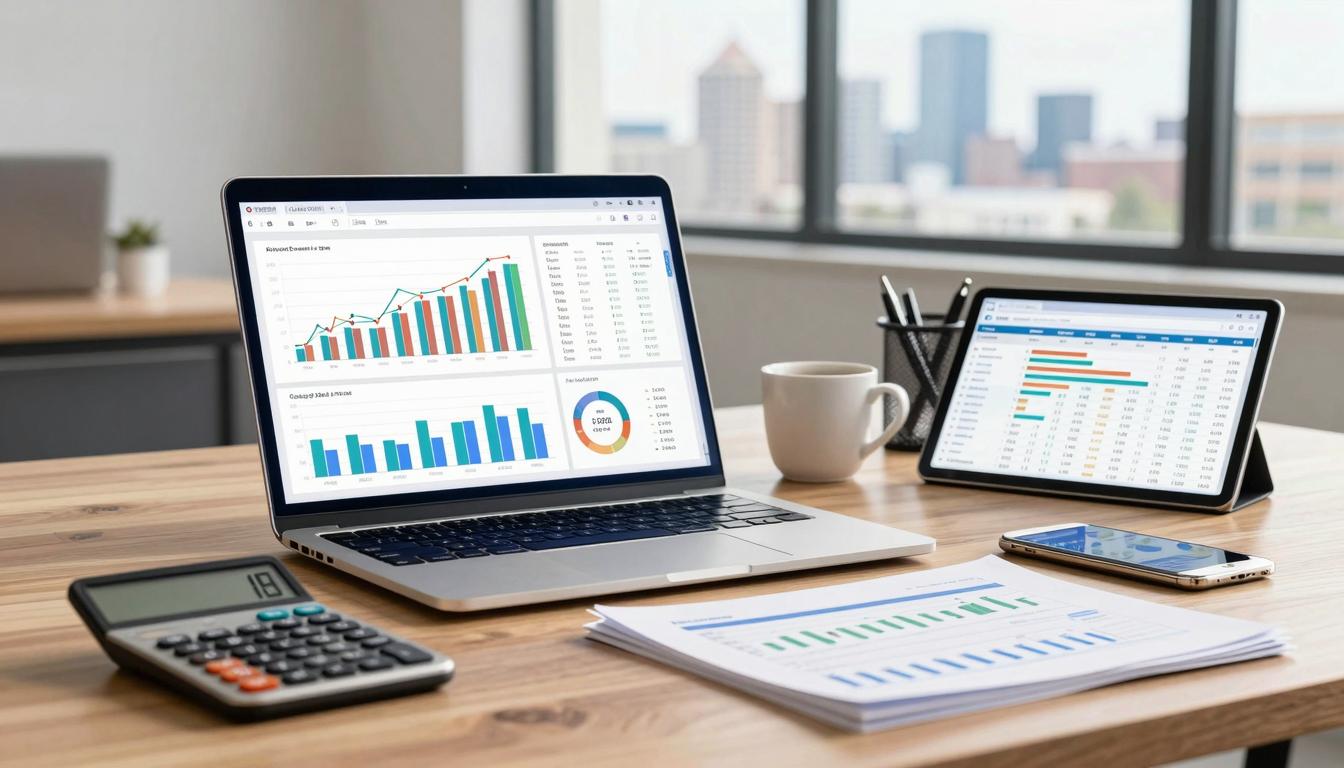
For SMBs, data analytics capabilities have typically been reserved for large corporations with dedicated analytics teams. However, modern cloud accounting platforms now include built-in analytics dashboards that visualize financial data in meaningful ways. These dashboards convert raw numbers into patterns that reveal business trends, anomalies, and opportunities.
Consider a retail business using cloud accounting with analytics capabilities. Instead of simply knowing total revenue for the month, the owner can see:
- Revenue trends by product category across multiple time periods
- Customer acquisition cost versus lifetime value metrics
- Seasonal patterns that inform inventory planning
- Profitability by sales channel or geographic location
- Cash flow forecasts based on historical patterns and current receivables
- Expense patterns that highlight cost reduction opportunities
The power of analytics extends beyond historical reporting. Predictive analytics uses historical data to forecast future outcomes. An SMB can project cash flow for the next quarter, identify customers at risk of default before invoices become overdue, or anticipate seasonal inventory needs. This proactive approach reduces financial surprises and enables better strategic planning.
Another critical benefit is anomaly detection. Analytics tools can automatically flag unusual transactions or patterns that might indicate fraud, data entry errors, or operational issues. For SMBs with limited internal controls, this automated oversight provides valuable protection.
Integrating cloud accounting and analytics into decision-making processes
The real value of combining cloud accounting and data analytics emerges when these tools become integral to decision-making processes. Many SMB owners still operate with a disconnect: they collect financial data but fail to use it strategically. Bridging this gap requires intentional integration into how businesses operate.
Effective integration begins with establishing key performance indicators (KPIs) aligned with business objectives. Rather than monitoring everything, SMBs should focus on metrics that directly impact their specific business. A software-as-a-service company might prioritize monthly recurring revenue growth and customer churn rates, while a manufacturing business might focus on gross margin per product line and inventory turnover.
Once KPIs are defined, cloud accounting systems can be configured to track and report these metrics automatically. Instead of manually assembling reports, data flows from transactional systems into dashboards that update daily or in real-time. This creates a continuous feedback loop where business performance is always visible.
The integration also improves cross-functional communication. When a sales manager can see that improving collections by five days would increase cash flow by $50,000, they’re more motivated to support the accounting department’s collection efforts. When marketing can see the actual customer acquisition cost derived from financial data, budget allocation decisions become more scientific.
Implementation requires three key steps:
- Define strategic questions: What decisions do you make regularly? What information would improve those decisions? Start here rather than with available data.
- Map data sources: Identify where the necessary information lives in your systems. Cloud accounting holds financial data, but you may need to integrate customer relationship management, inventory, or project management systems.
- Design reporting structure: Create dashboards and reports that deliver answers to your strategic questions in a format your team can easily interpret and act upon.
Many SMBs make the mistake of trying to extract every possible insight from their data. This creates information overload and analysis paralysis. Instead, start with a few critical metrics that directly inform your most important business decisions. You can expand the analytics framework over time as your team becomes more data-literate and your business matures.
Overcoming implementation challenges and maximizing adoption
Despite the clear benefits, many SMBs struggle with implementing cloud accounting and analytics solutions effectively. Common obstacles include resistance to change, lack of technical expertise, concerns about data security, and difficulty justifying the investment.
Addressing change resistance requires clear communication about benefits and a structured implementation plan. Rather than forcing the entire company to switch systems simultaneously, many successful SMBs implement in phases. The accounting department might transition first, followed by accounts payable and receivable functions, then expand to other departments. This phased approach allows teams to build competency gradually and troubleshoot issues in controlled environments.
Technical expertise can be addressed through vendor-provided training, documentation, and sometimes hiring a consultant for the implementation phase. Most modern cloud accounting platforms are designed for business users rather than IT specialists, with intuitive interfaces that minimize required technical knowledge.
Security concerns are often overblown. Cloud accounting vendors typically employ more sophisticated security measures than most SMBs could implement independently. They maintain encryption protocols, backup systems, redundant servers, and compliance certifications that exceed what traditional on-premise systems offer. The key is selecting a reputable vendor with established security credentials and SOC 2 compliance certifications.
For ROI justification, quantify specific benefits. A ten-person accounting department might spend 200 hours monthly on manual reconciliation, invoice processing, and report generation. Cloud automation reduces this to 100 hours, freeing 100 hours that could be redirected to analysis and strategy. At a fully-loaded cost of $50 per hour, that’s $5,000 monthly savings or $60,000 annually. A cloud accounting subscription typically costs $2,000 to $5,000 annually, representing a return on investment of ten to twenty times.
Maximizing adoption also requires ongoing support and reinforcement. Designate internal champions who become expert users and peer trainers. Celebrate early wins and share stories of how the new systems enabled better decisions or prevented problems. When team members understand how their daily work contributes to better business intelligence, adoption naturally improves.
Conclusion
The combination of cloud accounting and data analytics represents a fundamental shift in how SMBs can compete and grow. By moving financial management to the cloud, businesses gain accessibility, scalability, and built-in automation that were previously unavailable to companies without substantial IT budgets. Adding analytics capabilities transforms this financial data into strategic intelligence that informs better decisions about cash flow, profitability, customer relationships, and resource allocation.
The implementation journey requires thoughtful planning and change management, but the investment returns substantial dividends. SMBs that successfully integrate these technologies gain competitive advantages that previously belonged exclusively to larger enterprises. The path forward involves selecting appropriate solutions aligned with your business needs, defining clear KPIs connected to strategic objectives, and building a culture where data-driven decision-making becomes standard practice. For SMBs ready to embrace this transformation, the payoff extends far beyond accounting efficiency, enabling sustainable growth and strategic agility in an increasingly competitive marketplace.

news via inbox
Nulla turp dis cursus. Integer liberos euismod pretium faucibua