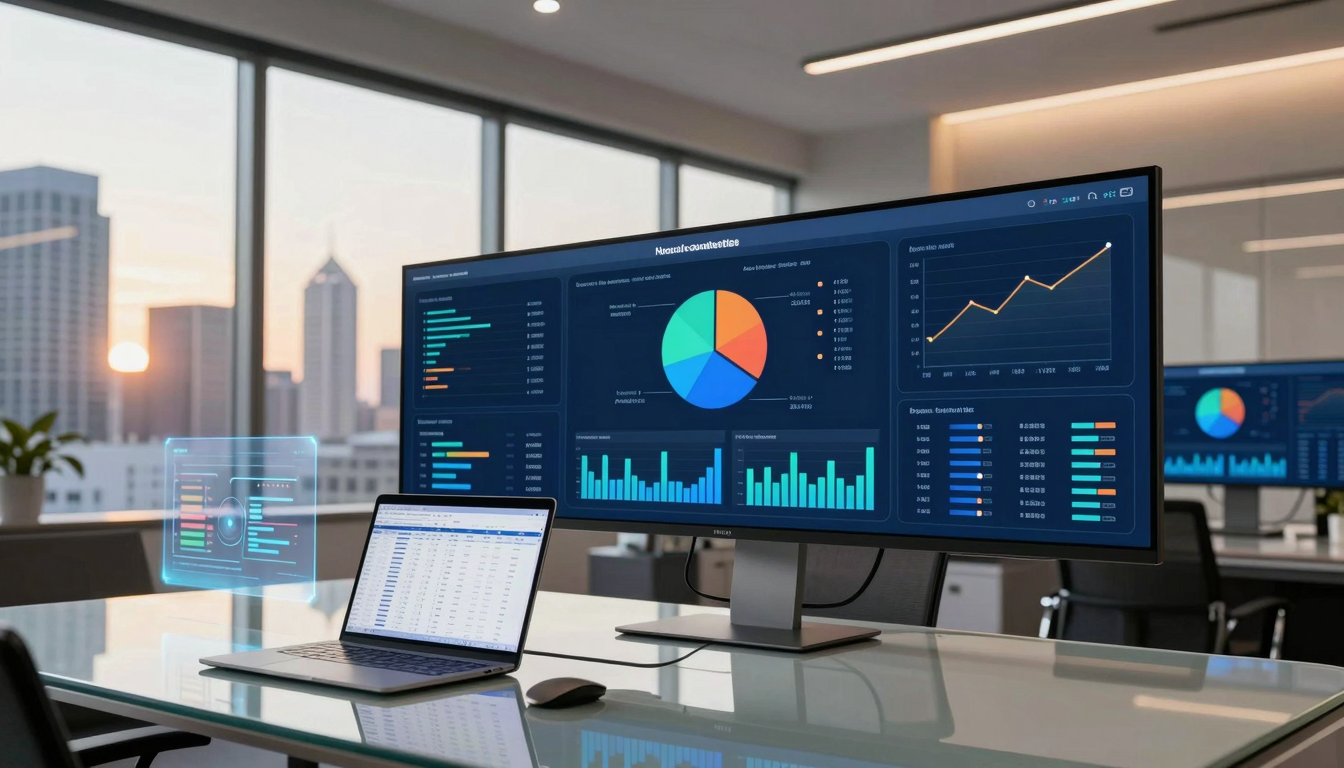
Data-Driven Accounting: Leveraging Analytics for Business Intelligence and Cost Management
Data-driven accounting: leveraging analytics for business intelligence and cost management
Introduction
In today’s competitive business landscape, organizations are increasingly recognizing that accounting extends far beyond traditional record-keeping and financial reporting. Data-driven accounting represents a fundamental shift in how businesses approach financial management, transforming raw numbers into actionable intelligence that drives strategic decision-making. By harnessing advanced analytics and data visualization tools, companies can now extract meaningful insights from their financial data, enabling them to optimize costs, identify trends, and uncover opportunities for growth. This article explores how modern businesses can leverage analytics within their accounting functions to enhance business intelligence capabilities and implement more effective cost management strategies. We’ll examine the technologies, methodologies, and best practices that enable organizations to move beyond reactive financial reporting toward proactive financial analysis, ultimately creating competitive advantages and supporting long-term business success.
Understanding the evolution of accounting analytics
Accounting has undergone a remarkable transformation over the past two decades. Traditionally, accounting departments operated as compliance centers, focusing primarily on recording transactions, preparing financial statements, and ensuring regulatory adherence. While these functions remain important, the emergence of sophisticated data analytics tools has expanded the scope of accounting significantly.
The shift toward data-driven accounting began with the digitalization of financial records. When companies moved from paper-based systems to enterprise resource planning (ERP) platforms, they gained access to vast amounts of structured financial data. However, having data available and effectively utilizing it are two entirely different matters. Many organizations initially failed to recognize the potential hidden within their financial databases.
Today’s accounting analytics encompasses several key dimensions. Descriptive analytics answers the fundamental question of what happened by analyzing historical data. Diagnostic analytics explores why something occurred by examining patterns and correlations. Predictive analytics forecasts future outcomes based on historical trends, while prescriptive analytics recommends specific actions to achieve desired results. Modern accounting departments now employ all four types to create comprehensive financial intelligence systems.
The integration of artificial intelligence and machine learning has accelerated this evolution. These technologies automate routine accounting tasks like invoice processing and expense categorization, freeing accounting professionals to focus on analysis and interpretation. This represents a significant departure from the traditional role of accountants as data processors to their emergence as strategic business advisors.
Core technologies and tools in data-driven accounting
Implementing a data-driven accounting system requires selecting and implementing appropriate technologies. The accounting technology stack has become increasingly sophisticated, with numerous solutions available to organizations of all sizes.
Enterprise Resource Planning (ERP) systems serve as the foundation for most modern accounting operations. Platforms like SAP, Oracle, and Microsoft Dynamics consolidate financial data from across an organization, providing a unified source of truth. These systems capture transaction data in real-time, enabling up-to-the-minute financial reporting rather than the month-end closures that characterized traditional accounting.
Beyond ERP systems, specialized analytics platforms have emerged to extract insights from financial data. Business intelligence tools such as Tableau, Power BI, and Looker enable accountants to create interactive dashboards and visualizations that reveal patterns invisible in traditional financial statements. These tools allow users to ask questions of their data, drill down into specific areas, and create customized reports without requiring extensive technical expertise.
Cloud-based accounting software has democratized access to sophisticated financial management tools. Solutions like Xero, QuickBooks Online, and NetSuite provide real-time visibility into financial performance while reducing the infrastructure burden on organizations. The cloud-based model also facilitates collaboration among accounting teams working remotely or across multiple locations.
Data warehousing solutions consolidate information from multiple source systems, creating a centralized repository optimized for analysis. These systems allow accountants to combine financial data with operational and commercial data, providing holistic insights into business performance.
Automation tools represent another critical component of the technology stack. Robotic process automation (RPA) handles repetitive tasks like data entry, invoice matching, and reconciliation. This automation not only reduces errors but also significantly accelerates financial processes. Accounting teams using RPA report cycle time reductions of 30-50% for common accounting processes.
| Technology category | Primary function | Key benefits | Implementation complexity |
|---|---|---|---|
| ERP systems | Central transaction processing and financial record keeping | Real-time data, integrated processes, scalability | High |
| Business intelligence tools | Data visualization and interactive analysis | Accessibility, custom reporting, pattern recognition | Medium |
| Cloud-based accounting software | Financial management and collaborative access | Lower infrastructure costs, flexibility, accessibility | Low to medium |
| Data warehouses | Centralized data repository for analysis | Comprehensive analysis, historical trends, integration | High |
| Automation and RPA | Routine process execution | Error reduction, speed, cost savings | Medium |
Organizations should approach technology selection strategically. Rather than implementing all available tools simultaneously, successful companies typically adopt a phased approach, starting with foundational systems and progressively adding specialized tools as the organization’s analytics maturity increases.
Transforming cost management through analytics
One of the most immediate and impactful applications of accounting analytics is cost management. Traditional approaches to cost control often rely on static budgets and periodic variance analyses. Data-driven cost management, by contrast, enables continuous monitoring and dynamic optimization of expenses.
Real-time expense tracking represents a fundamental shift in how organizations approach cost management. Rather than discovering cost overruns during monthly reconciliation, analytics tools provide immediate visibility into spending patterns. This enables faster corrective action and prevents minor cost issues from escalating into significant problems.
Analytics reveals cost patterns that would be invisible through traditional accounting. For instance, by analyzing spending across time periods, departments, suppliers, and project categories simultaneously, organizations can identify non-obvious inefficiencies. A company might discover that certain departments consistently overspend on specific categories, that costs spike during particular seasons due to preventable factors, or that consolidating purchases across departments could yield better pricing.
Predictive cost modeling allows organizations to forecast future costs with greater accuracy than traditional approaches. By analyzing historical spending patterns alongside operational metrics, companies can project future costs and adjust operations accordingly. A manufacturing company, for example, can correlate raw material costs with production volumes to better forecast total production expenses. Retail organizations can link inventory carrying costs to sales volumes to optimize stock levels.
Supplier analysis becomes more sophisticated with data analytics. Rather than treating all suppliers equally, companies can analyze spending patterns, payment terms, quality metrics, and reliability data to identify opportunities for better partnerships. Analytics might reveal that consolidating purchases with fewer suppliers could improve pricing, or that diversifying suppliers in a particular category could reduce risk and costs.
Zero-based budgeting gains practical feasibility through analytics. Traditionally, zero-based budgeting required substantial manual effort to justify every expense from scratch. Analytics tools can now identify the drivers of spending and establish baseline costs based on operational requirements. This creates more accurate and defensible budgets while highlighting areas where spending exceeds operational requirements.
Cost allocation becomes more precise with analytics. Many organizations struggle with accurately allocating indirect costs across departments and projects. Analytics tools can analyze resource consumption patterns and implement activity-based costing more effectively, providing more accurate profitability analysis by business unit, customer segment, or product line.
Building business intelligence through financial analytics
Beyond cost management, accounting analytics enables the creation of comprehensive business intelligence systems that inform strategic decisions. Financial data, when properly analyzed, reveals insights about business performance that extend far beyond traditional profitability metrics.
Profitability analysis becomes multidimensional with analytics. Rather than examining overall company profitability, organizations can analyze profitability by customer, product, market segment, sales channel, or geographic region. This granular analysis often reveals surprises. A company might discover that its largest customer is among its least profitable, or that a small market segment generates disproportionately high returns. Armed with these insights, management can make strategic decisions about where to focus resources and which customer relationships to prioritize or restructure.
Cash flow intelligence represents another critical area where analytics adds significant value. By analyzing the components of cash flow in detail, companies can identify seasonal patterns, forecast cash requirements more accurately, and optimize working capital management. Analytics can reveal, for instance, that payment delays from certain customers create predictable cash flow challenges, or that inventory levels vary seasonally in ways that could be optimized to reduce financing needs.
Performance metrics dashboards provide ongoing visibility into key financial indicators. Rather than reviewing performance quarterly or monthly, management teams can access real-time dashboards showing key performance indicators, trends, and variances from targets. These dashboards enable faster decision-making and earlier intervention when performance drifts from expectations.
Variance analysis becomes more sophisticated and actionable. Traditional variance analysis often identifies that expenses exceeded budget but provides limited insight into causes. Analytics tools can drill into variances to identify root causes. When labor costs exceed budget, analytics can determine whether the variance stems from hiring additional staff, wage increases, overtime costs, or reduced productivity. This level of detail enables management to understand the drivers of performance and take targeted corrective actions.
Trend analysis and forecasting enable forward-looking decision making. By analyzing historical trends and combining them with leading indicators, organizations can project future performance and identify emerging issues. A company might notice that gross margins have gradually declined over several quarters. Analytics can help determine whether this reflects market pricing pressure, product mix changes, or rising input costs, enabling management to develop appropriate responses.
Integration of financial and operational data creates particularly powerful intelligence. By combining financial information with operational metrics, companies can better understand performance drivers. Healthcare organizations, for instance, can correlate patient volumes and acuity levels with financial performance. Manufacturing companies can analyze production efficiency alongside material costs. Retail organizations can link sales data with inventory carrying costs. These integrated analyses reveal relationships and opportunities that neither financial nor operational data alone could provide.
Implementing data-driven accounting successfully
Transitioning to data-driven accounting requires more than simply purchasing new software. Successful implementation demands organizational changes, skills development, and cultural shifts.
Data governance represents a critical foundation. Organizations must establish clear standards for data definition, quality, and management. Without effective data governance, analytics efforts produce unreliable results. Data governance includes documenting how data should be recorded, establishing quality standards and validation rules, maintaining data lineage so users understand where data originates, and establishing access controls to protect sensitive information. Many analytics projects fail not because of technical limitations but because of poor data quality or inconsistent data definitions across systems.
Building analytical capability requires developing skills across the accounting organization. Some staff members will require deep technical skills in data analysis, statistics, and programming. However, all accounting professionals should develop basic analytical skills, including the ability to interpret data visualizations, ask appropriate questions of data, and understand analytical concepts. Training programs should combine both technical tools training and conceptual understanding.
Change management deserves particular attention. Many accounting professionals may feel threatened by automation and analytics, fearing job elimination. Leadership must clearly communicate how analytics and automation will change roles rather than eliminate them. Staff should understand that automation will eliminate tedious tasks, freeing them to focus on higher-value analytical and strategic work. Organizations that successfully implement data-driven accounting typically invest significantly in change management and staff development.
Starting with clear objectives increases implementation success rates. Rather than implementing analytics broadly, successful organizations typically begin with specific business problems they want to solve. A company might start by implementing cost analytics to address a known cost control problem, or develop a cash flow analysis tool to address working capital management challenges. Starting with tangible business objectives ensures alignment between analytics initiatives and business needs, and provides clear metrics to demonstrate value.
Phased implementation enables organizations to learn and refine their approach over time. Rather than attempting a comprehensive transformation immediately, successful implementations often unfold over 12-24 months, with each phase building on previous successes. This approach allows organizations to build skills, refine processes, and demonstrate value incrementally rather than risking a massive all-or-nothing transformation.
Executive sponsorship proves critical to implementation success. Data-driven accounting requires investment in technology, training, and process redesign. These investments require executive commitment and funding. Additionally, executive engagement signals organizational priority and encourages accountability and participation throughout the finance function.
Conclusion
Data-driven accounting represents a fundamental reimagining of the accounting function’s role in modern organizations. By leveraging analytics technologies and methodologies, accounting departments transform from compliance centers focused on historical reporting into strategic business intelligence units that drive decision-making and performance optimization. The technologies enabling this transformation continue to advance, with artificial intelligence and machine learning increasingly automating routine tasks and enabling more sophisticated analysis. Organizations that successfully implement data-driven accounting gain competitive advantages through more effective cost management, better-informed decision making, and improved financial performance. However, technological capability alone proves insufficient. Success requires complementary investments in data governance, staff skills development, and organizational change management. For most organizations, the transition to data-driven accounting represents a multi-year journey rather than a single implementation project. Those who commit to this journey systematically, starting with clear business objectives and building capability incrementally, position themselves to realize substantial benefits. As business environments continue to evolve and data becomes increasingly central to competitive advantage, the ability to extract actionable insights from financial data will become not a differentiator but a fundamental requirement for organizational success.

news via inbox
Nulla turp dis cursus. Integer liberos euismod pretium faucibua