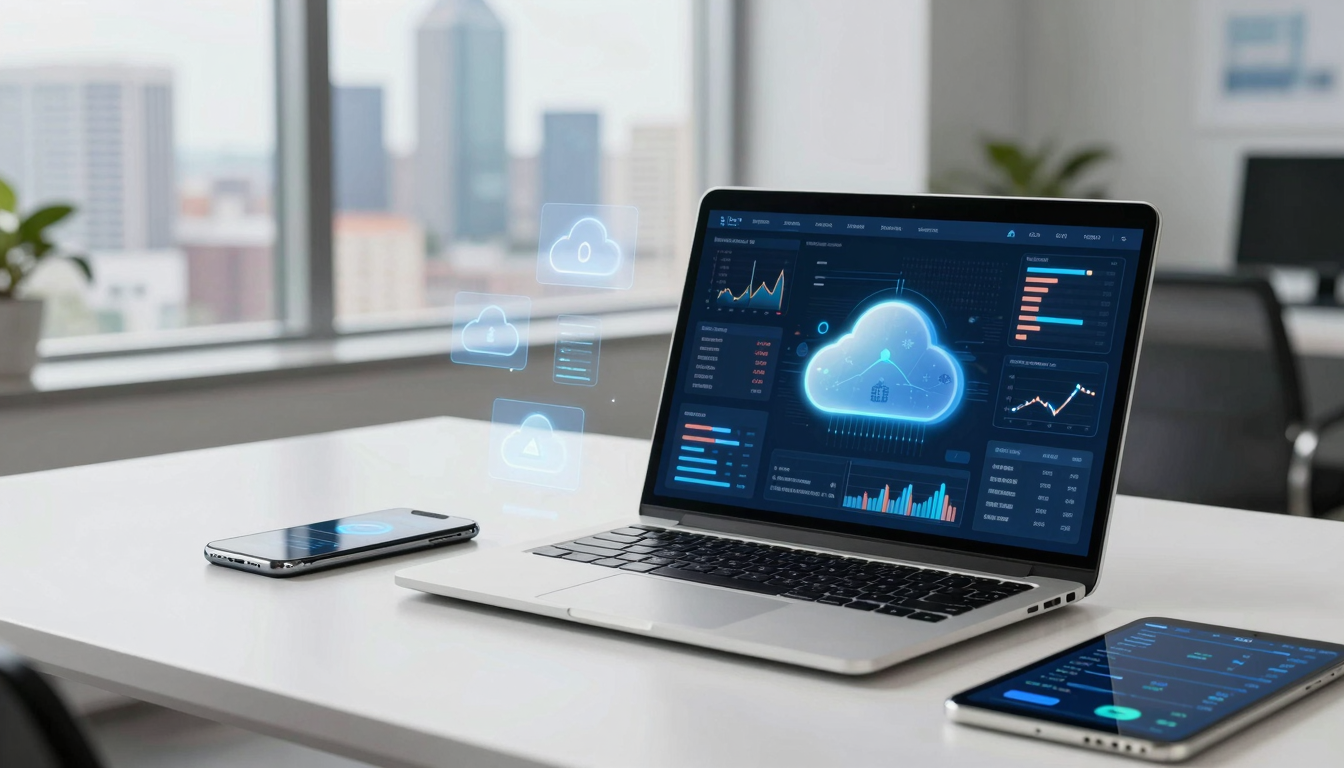
Integrating Cloud Accounting Solutions for SMBs to Boost Efficiency
Integrating Cloud Accounting Solutions for SMBs to Boost Efficiency
Introduction
Small and medium-sized businesses (SMBs) face unprecedented challenges in managing their financial operations with limited resources. Traditional accounting methods involving manual data entry, spreadsheets, and on-premise software can drain valuable time and create costly errors. Cloud accounting solutions offer a transformative approach to this problem, enabling SMBs to streamline their financial processes, reduce administrative burden, and gain real-time visibility into their business performance. In this article, we’ll explore how integrating cloud accounting solutions can significantly boost efficiency across your organization, from automating routine tasks to enhancing collaboration between teams. We’ll examine the key benefits, implementation strategies, and practical considerations that SMBs should understand before making this important transition. Whether you’re looking to improve cash flow management, strengthen financial reporting, or simply want to work smarter, cloud accounting represents a strategic investment for modern SMBs seeking competitive advantage in today’s digital economy.
Understanding cloud accounting and its core advantages
Cloud accounting fundamentally transforms how businesses manage their financial data by moving from traditional desktop-based systems to internet-based platforms. Rather than storing information on local servers or personal computers, cloud solutions host your accounting data on secure remote servers, accessible from anywhere with an internet connection. This shift represents more than just a technical upgrade; it’s a paradigm change in how financial operations function within an organization.
For SMBs, the advantages are substantial and multifaceted. Real-time data accessibility means that business owners, accountants, and managers can view financial information simultaneously, eliminating delays caused by email exchanges or file transfers. This immediacy enables faster decision-making and more accurate financial forecasting. Additionally, cloud accounting solutions automatically update and synchronize across all devices, ensuring that everyone works with current information rather than outdated spreadsheets.
The cost efficiency of cloud accounting cannot be overstated. SMBs no longer need to invest in expensive hardware infrastructure or maintain dedicated IT staff to manage on-premise systems. Cloud solutions operate on subscription models, typically ranging from $10 to $300 monthly depending on features and complexity, making them accessible even for startups. This predictable expense structure allows for better budget planning compared to the unpredictable costs of maintaining legacy systems.
Security represents another critical advantage that often surprises business owners. Cloud accounting providers employ enterprise-level security measures, including:
- 256-bit encryption for data transmission and storage
- Automatic daily backups with disaster recovery protocols
- Multi-factor authentication for user access
- Regular security audits and compliance certifications (SOC 2, ISO 27001)
- Automatic software updates and security patches
Most SMBs cannot afford to implement these security measures independently, making cloud solutions actually safer than maintaining their own systems. Furthermore, cloud accounting platforms offer scalability that grows with your business. As your company expands, you can easily add users, features, or additional modules without the technical complications of upgrading on-premise infrastructure.
Automation and workflow optimization through cloud solutions
One of the most transformative aspects of cloud accounting is its ability to automate routine financial tasks that consume disproportionate amounts of time in traditional accounting processes. SMBs typically spend countless hours on data entry, invoice processing, and reconciliation activities that don’t contribute to strategic decision-making.
Modern cloud accounting platforms leverage automation capabilities that dramatically reduce manual work. Invoice entry, for example, can now be automated through optical character recognition (OCR) technology that reads invoice images or PDFs and automatically populates your accounting system. Bank transactions feed directly into your accounting software through open banking connections, eliminating the need for manual categorization of routine transactions. Expense tracking becomes seamless when employees can photograph receipts that are automatically captured, classified, and associated with projects or cost centers.
The workflow optimization extends to payment processing as well. Recurring invoices can be generated and sent automatically on predetermined schedules, ensuring consistent cash flow and reducing the administrative overhead of creating individual invoices. Similarly, payment reminders can be scheduled to go out automatically when invoices approach their due dates, improving collection rates without requiring manual intervention.
Consider the implications of these automations for a typical SMB with three accounting staff members. Time saved through automation typically breaks down as follows:
| Task | Time per month (traditional) | Time per month (cloud automated) | Monthly hours saved |
|---|---|---|---|
| Invoice data entry | 40 hours | 8 hours | 32 hours |
| Bank reconciliation | 20 hours | 4 hours | 16 hours |
| Expense categorization | 15 hours | 2 hours | 13 hours |
| Payment processing | 10 hours | 2 hours | 8 hours |
| Report generation | 12 hours | 3 hours | 9 hours |
| Total | 97 hours | 19 hours | 78 hours |
These 78 monthly hours represent nearly two full-time employees worth of capacity that can be redirected toward financial analysis, strategic planning, and business development rather than repetitive data entry. This time reallocation directly translates to improved efficiency and the ability to handle business growth without proportionally increasing accounting staff.
Beyond time savings, automation reduces human error significantly. Manual data entry typically introduces errors at a rate of 1-2%, whereas cloud systems with automated data capture achieve accuracy rates exceeding 99.9%. These errors, when compounded across thousands of transactions, create reconciliation challenges and potentially misleading financial reports. Automation eliminates this error source entirely, improving financial data quality and reducing the time spent on corrections and investigation.
Enhancing financial visibility and informed decision-making
Cloud accounting solutions provide SMBs with unprecedented visibility into their financial performance through customizable dashboards and real-time reporting capabilities. Unlike traditional accounting systems that require accountants to generate reports on demand, cloud platforms enable business owners and managers to access financial insights instantly whenever they need them.
The real-time reporting feature is particularly valuable for SMBs that need to make quick decisions based on current financial conditions. A business owner can check their cash position, accounts receivable aging, or monthly profitability in seconds rather than waiting days for their accountant to prepare reports. This immediacy enables proactive financial management rather than reactive responses to problems that have already developed.
Cloud accounting platforms offer sophisticated financial analytics that were previously available only to large enterprises with dedicated financial analysts. These capabilities include:
- Profit and loss analysis by product, service, or customer segment
- Cash flow forecasting based on historical patterns and future projections
- Key performance indicator (KPI) tracking tailored to your industry
- Budget versus actual comparisons to monitor spending discipline
- Customer profitability analysis to identify your most valuable accounts
- Trend analysis showing performance changes over quarters or years
These analytical capabilities transform accounting from a compliance function into a strategic business tool. A retail SMB, for instance, can analyze which product categories generate the highest margins rather than just tracking overall sales. A service-based business can identify which clients are most profitable when accounting for the actual cost of serving them, potentially informing pricing strategies or service mix decisions.
The integration capabilities of modern cloud accounting platforms amplify their value by connecting with other business systems. When your accounting system integrates with your customer relationship management (CRM) platform, you gain the ability to link financial performance with customer interactions. Integration with inventory management systems allows you to analyze inventory holding costs against sales velocity. Point-of-sale (POS) system integration ensures that sales data flows directly into your accounting records without manual intervention.
These integrations create what might be called a “financial intelligence ecosystem” where data flows seamlessly between systems, creating a comprehensive view of business performance. Instead of maintaining separate databases that never communicate, you have a unified information environment where accounting data enriches operational insights and operational data informs financial analysis.
For SMBs with multiple locations or distributed teams, cloud accounting enables centralized financial control without sacrificing operational autonomy. Regional managers can input local data through the cloud interface, but headquarters maintains consistent reporting and financial oversight. This capability proves essential for growing businesses that need to maintain financial discipline while scaling operations.
Implementation strategy and overcoming common obstacles
Transitioning to cloud accounting requires careful planning to ensure a smooth implementation that minimizes disruption to your business. Many SMBs fail to achieve the full potential of their cloud accounting investment due to poorly planned migrations or inadequate user adoption. A structured implementation approach can prevent these common pitfalls.
The first step involves selecting the appropriate solution for your specific business needs. Different cloud accounting platforms excel in different areas. QuickBooks Online suits businesses needing comprehensive accounting functionality with strong integration options. Xero appeals to businesses prioritizing user-friendly interfaces and strong reporting capabilities. Freshbooks serves service-based businesses particularly well. Wave offers cost-effective solutions for very small businesses with simpler accounting needs. Evaluating your specific requirements before implementation prevents the costly mistake of selecting a platform that doesn’t align with your business model.
Data migration represents the most challenging aspect of implementation. Historical data transfer requires careful planning to ensure that opening balances, customer information, vendor records, and transaction history migrate accurately. Many cloud providers offer migration services, though these often incur additional fees. SMBs must decide whether to migrate all historical data or begin with a clean slate using a cutover date. While starting fresh simplifies the migration process, maintaining historical data provides continuity for reporting and analysis.
User training often receives insufficient attention despite being critical to success. Comprehensive user training should address not just how to use the system, but why procedures are changing and how new workflows improve efficiency. When accounting staff understand that cloud accounting eliminates tedious manual tasks and enables more meaningful work, adoption resistance diminishes. Training should occur in phases, with initial training for core users followed by ongoing support as other employees encounter the system in their workflows.
Organizations frequently encounter these obstacles during implementation:
- Data quality concerns: Migrating bad data into your cloud system perpetuates existing problems. Pre-migration data cleansing, though time-consuming, prevents ongoing issues.
- Insufficient bandwidth: Cloud systems require reliable internet connections. SMBs in areas with poor connectivity may face performance challenges.
- Integration complications: Connecting cloud accounting with other business systems sometimes proves more complex than anticipated, requiring technical support.
- Change resistance: Employees accustomed to existing systems may resist new workflows, requiring patience and management support.
- Customization limitations: Cloud platforms offer less customization than on-premise systems, potentially requiring businesses to adjust processes rather than customizing software.
Successful SMBs overcome these obstacles by establishing a dedicated implementation team with clear leadership and accountability. Designating an implementation champion from within your organization ensures continuity and institutional knowledge. This person becomes the primary point of contact with your cloud provider, manages user training, and coordinates the transition process.
A phased rollout approach also improves outcomes. Rather than migrating your entire company to cloud accounting simultaneously, consider implementing by department or by functionality. Starting with accounts payable, then adding accounts receivable, then general ledger allows users to master each module before moving to the next. This approach reduces overwhelm and provides opportunities to address issues before they cascade through your organization.
The implementation timeline matters significantly. Most cloud accounting implementations for SMBs require 4-12 weeks depending on data complexity and organizational readiness. Rushing implementation to meet artificial deadlines typically results in incomplete data migration or inadequate user training. Conversely, extending implementation indefinitely creates perpetual disruption. Establishing realistic timelines with clear milestones and accountability measures maintains momentum while ensuring thorough completion.
Conclusion
Cloud accounting solutions represent a fundamental opportunity for SMBs to enhance operational efficiency while controlling costs. By automating routine financial tasks, providing real-time financial visibility, and enabling sophisticated analysis previously available only to larger organizations, cloud platforms democratize financial management. The transition from traditional accounting methods to cloud-based systems requires thoughtful planning and dedicated change management, but the returns on this investment are substantial and measurable.
SMBs that successfully integrate cloud accounting solutions typically experience 30-40% reduction in time spent on routine accounting tasks, improved cash flow management through better visibility, and enhanced decision-making capabilities enabled by real-time reporting. Beyond these operational improvements, cloud accounting provides the scalability to support business growth without proportional increases in administrative overhead. The security and compliance features built into modern cloud platforms often exceed what SMBs could achieve independently. As your business evolves and becomes more complex, cloud accounting grows with you, adapting to changing needs without requiring expensive system replacements. The question is no longer whether SMBs should consider cloud accounting, but rather how quickly they can implement these solutions to gain competitive advantage in an increasingly digital business environment. The efficiency gains alone justify the investment, while the strategic insights enabled by robust financial data position your business for sustainable growth.

news via inbox
Nulla turp dis cursus. Integer liberos euismod pretium faucibua